

The US commercial real estate (CRE) market has kicked off 2025 with a modest but promising uptick in prices. January saw a 0.3% increase year-over-year (YoY), giving us a glimmer of hope after months of price fluctuations and uncertainty. While it’s just a small step, it could be the start of a bigger upswing in the market.
The Numbers Tell the Story
For those who like to see the numbers, January marked the fourth consecutive month of price increases, with a solid 0.5% rise month-over-month (MoM). According to MSCI’s RCA Commercial Property Price Index (CPPI), that translates to an impressive annualized growth rate of 6.5%. But let’s not get ahead of ourselves—there’s still a lot weighing on the market. Inflation, rising borrowing costs, and shifting dynamics are all contributing to uneven growth, and we’re likely to see more bumps along the road in the short term.
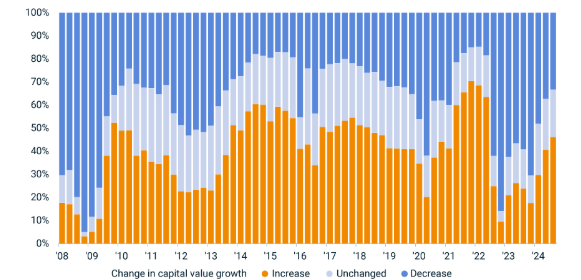
Source: MSCI Global Quarterly Property Index
Retail: The Unexpected Star
If there’s one sector that stood out in January, it’s retail. While many other commercial property sectors are facing challenges, retail posted a robust 5% YoY increase in property prices and 1.5% MoM growth. This translates to a stunning annualized growth rate of 18.9%. Despite the ongoing economic headwinds, retail is proving to be remarkably resilient. The rise in consumer spending and the ever-growing demand for brick-and-mortar stores are fueling this sector’s recovery. It seems retail is ready to make a strong comeback.
Industrial: Holding Steady with a Hint of Stabilization
The industrial sector continues to show steady growth, with a 3.4% increase in YoY prices. January marked the seventh month of consistent annual growth for industrial properties. However, there was no MoM change, signaling a possible stabilization after years of rapid expansion. While industrial properties outperformed other sectors in recent years, retail’s recent performance has slightly outpaced industrial in terms of price growth. Still, industrial remains a solid performer overall.
Apartments: Mixed Signals in a Challenging Market
The apartment market had a bit of a mixed bag in January. Prices slipped 1.6% YoY, but there was a slight MoM uptick of 0.7%, which suggests an annualized growth rate of 8.1%. The multifamily market continues to feel the pinch from rising interest rates and affordability issues, leaving the sector in a bit of a holding pattern. While apartments are not in crisis mode, the path forward remains uncertain, especially as renters face affordability challenges.
Office Properties: Struggling to Find Their Footing
If any sector is truly facing a tough time, it’s the office market. Prices in central business districts (CBDs) saw a dramatic 10% YoY decline in January, with suburban offices also facing challenges, down 1.5% YoY. Even though suburban offices showed a tiny 0.1% MoM increase, the sector continues to face significant headwinds. With remote work trends showing no signs of slowing down, office properties in urban centers are struggling to regain their footing.
Major vs. Non-Major Metros: A Shifting Landscape
When it comes to major metropolitan areas, January wasn’t kind. The six largest cities—Boston, Chicago, Los Angeles, New York, San Francisco, and Washington, DC—saw CRE prices drop 4.1% YoY. Meanwhile, non-major metros are starting to shine. Prices in smaller cities rose 0.8% YoY, and they even outperformed the big cities MoM. This shift in demand is noteworthy. As the cost of doing business in the most expensive cities continues to rise, investors and tenants are increasingly looking for opportunities in more affordable markets.
Looking Ahead: Uncertainty and Opportunity
So, what’s next for the US CRE market? The road ahead is still uncertain, with inflation, rising borrowing costs, and broader economic issues likely to continue influencing the market. These factors, combined with trade tensions and shifting global dynamics, will keep things unpredictable for the time being.
But not all hope is lost. Certain sectors, like retail and industrial, are proving resilient, while office properties in major urban centers are still struggling to recover. As we move through 2025, investors will need to stay agile, watching for shifts in demand and adjusting their strategies accordingly.
The CRE market may be in a state of flux, but for those who can navigate the ups and downs, there are still plenty of opportunities to capitalize on. The key will be understanding where the market is headed and positioning yourself for the best possible return on investment.
Source: https://www.credaily.com/


